Managing your tax obligations is an important part of running a successful business. For many Australian business owners, Pay As You Go (PAYG) instalments are a regular part of the financial year, but understanding how they work and how they affect cash flow can sometimes be challenging.
At AJ Buckingham & Associates, we believe that understanding your tax obligations is essential to making informed financial decisions. In this article, we explain what PAYG instalments are, how they are calculated and what to consider if your business circumstances change.
What are PAYG instalments?
Pay As You Go (PAYG) instalments are regular payments made towards your expected income tax liability on business and investment income.
Rather than paying your entire income tax liability after lodging your annual tax return, the PAYG instalment system allows you to make payments throughout the financial year. These payments are then credited against your final income tax assessment.
PAYG instalments are generally relevant to individuals who earn business or investment income, including sole traders and certain individuals with investment income. Companies and trusts may also have PAYG instalment obligations, depending on their circumstances.
It is important to understand that PAYG instalments are not an additional tax. They are prepayments towards your expected income tax liability.
PAYG instalments versus PAYG withholding
Although the terminology is similar, PAYG instalments and PAYG withholding serve different purposes.
- PAYG instalments are payments towards your expected income tax liability on business and investment income.
- PAYG withholding is tax withheld from payments such as employee wages and remitted to the Australian Taxation Office (ATO).
Understanding the distinction can help you better manage your business’s tax obligations and cash flow.
How are PAYG instalments calculated?
The ATO generally provides two methods for calculating PAYG instalments. The method available to you will depend on your circumstances and the information provided by the ATO.
1. Instalment amount method
Under this method, the ATO calculates an instalment amount using information from your previous tax assessment, with an adjustment where applicable.
The amount is generally displayed on your activity statement or instalment notice, making it relatively straightforward to budget for and pay.
However, because the calculation is based on historical information, the amount may not accurately reflect your current financial position.
For example, if your business income has declined since the previous financial year, your instalments may be higher than necessary. Conversely, if your income has increased, the instalments paid may not be sufficient to cover your eventual tax liability.
2. Instalment rate method
Under this method, your PAYG instalment is calculated by applying the instalment rate provided by the ATO to your actual instalment income for the relevant period.
This method may be suitable for businesses whose income fluctuates throughout the year, as the amount payable is linked more closely to current income.
For example, a seasonal business may experience significant variations in turnover between quarters. Calculating instalments using actual income can help payments better reflect the business’s current performance.
Choosing the appropriate method depends on your circumstances, and professional advice can help you understand which option is most suitable.
When are PAYG instalments due?
PAYG instalments are commonly paid quarterly through your activity statement or instalment notice. For standard quarterly reporting, the usual payment due dates are:
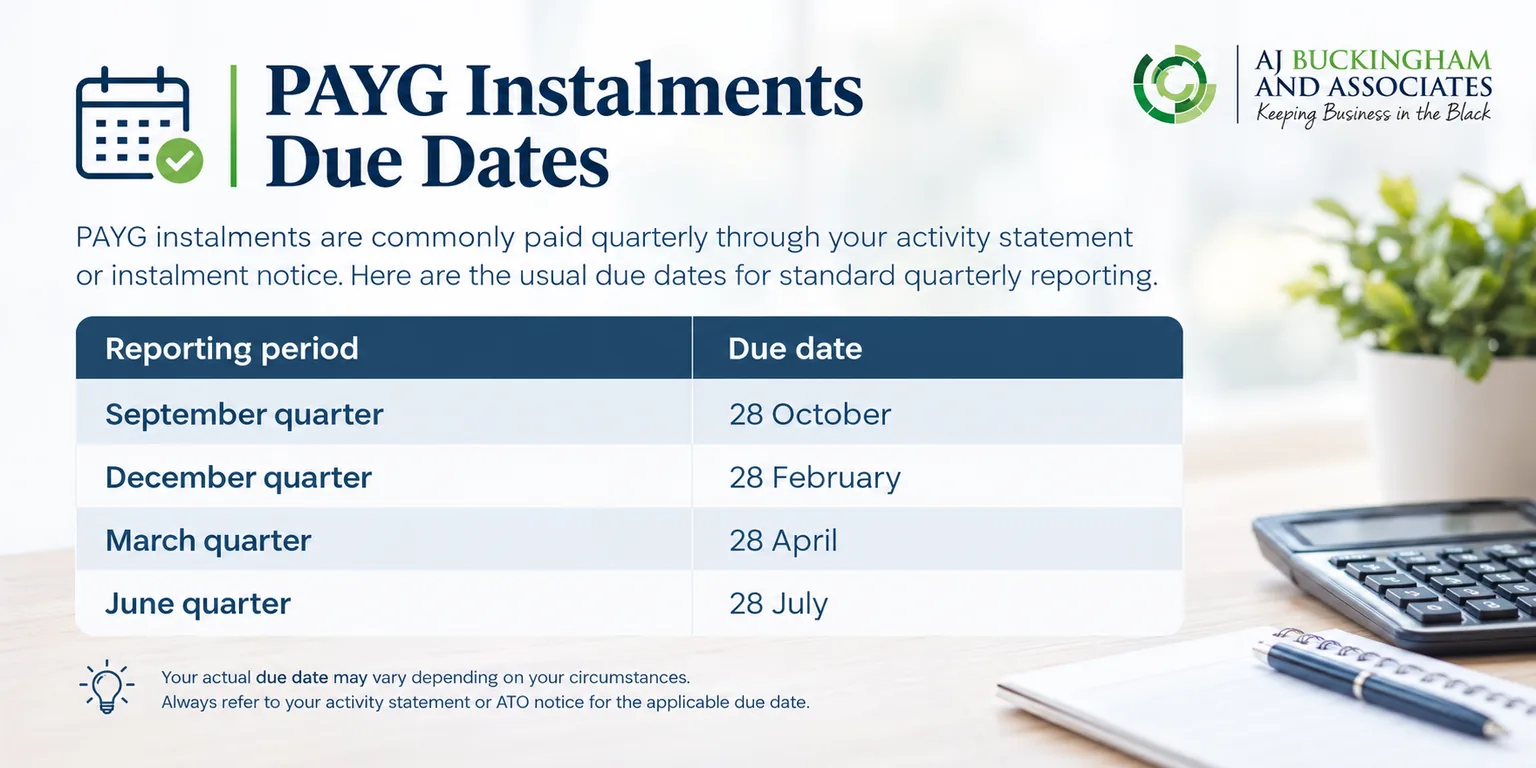
Different arrangements and concessions may apply depending on your circumstances. Always refer to your activity statement or ATO notice for the applicable due date.
Planning ahead for these payments can help reduce pressure on your business’s cash flow and minimise the risk of missed deadlines.
What happens when you lodge your tax return?
The PAYG instalments you pay throughout the financial year are credited against your final income tax liability when your tax return is assessed.
For example, if you pay $12,000 in PAYG instalments during the year and your final income tax liability is $13,000, the instalments paid will generally be credited against the amount owing, leaving a balance of $1,000.
If your final income tax liability is $10,000, the excess instalments may contribute to a refund, subject to your overall tax position and any other amounts payable or refundable.
This is why it is important to view PAYG instalments as part of your overall tax planning rather than as a separate business expense.
Can your PAYG instalments be varied?
Your business circumstances can change considerably from one financial year to the next. Changes in revenue, profitability, deductible expenses or business operations may affect your expected tax liability.
In certain circumstances, you may be able to vary your PAYG instalments to better reflect your expected tax position.
A variation may be worth considering if:
- Your business income has decreased significantly.
- Your business is experiencing lower profits than in the previous financial year.
- Your income has increased and your current instalments may be insufficient.
- Your business activities or financial circumstances have changed materially.
However, varying instalments requires careful consideration. If you reduce your instalments too much, you may face an unexpected tax bill and, in some circumstances, an interest charge.
Before making a variation, it is advisable to review your current financial information and estimated taxable income with your accountant.
At AJ Buckingham & Associates, we can assist you in assessing your circumstances and determining whether a variation may be appropriate.
Managing PAYG instalments and cash flow
Effective cash-flow management is essential to meeting your business obligations without placing unnecessary pressure on day-to-day operations.
PAYG instalments should be incorporated into your regular financial planning, alongside other obligations such as GST, PAYG withholding, superannuation and operating expenses.
Consider implementing the following practices:
- Set funds aside regularly. Allocate money towards upcoming tax payments as income is received.
- Monitor your financial performance. Review your revenue, expenses and profitability throughout the year.
- Review your tax position. Avoid relying solely on last year’s figures when assessing your current obligations.
- Plan for payment deadlines. Keep track of activity statement due dates and ensure funds are available when required.
- Seek advice when circumstances change. If your business experiences a significant change in profitability or cash flow, discuss your options with your accountant.
Taking a proactive approach can help you manage your obligations more effectively and reduce the likelihood of unexpected tax liabilities.
What if you are unable to pay your PAYG instalment?
If you are experiencing cash-flow difficulties and are concerned about meeting an upcoming payment, it is important to seek advice promptly rather than ignore the obligation.
We can review your current financial position, assess whether your instalment remains appropriate and discuss the options available to you.
If you are unable to pay an amount owed to the ATO, payment arrangements may be available depending on your circumstances. The ATO should be contacted as early as possible to discuss your position.
Early action can help you understand your options and make informed decisions about managing your tax obligations.
How we can can assist
Understanding your PAYG instalments is an important part of managing your business finances. While the system is designed to spread income tax payments throughout the year, the amount you pay should be considered in the context of your broader financial position.
At AJ Buckingham & Associates, we understand that every business has different financial circumstances. We can help you understand your PAYG instalment obligations, review your expected tax position and consider whether adjustments may be appropriate.
Taking a proactive approach to tax planning can help you manage cash flow, prepare for upcoming obligations and make more informed decisions for your business.
Need assistance with your PAYG instalments?
Contact AJ Buckingham & Associates to discuss your circumstances and how we can help you manage your tax obligations with greater confidence.
For more information about PAYG instalments, please click the link below: