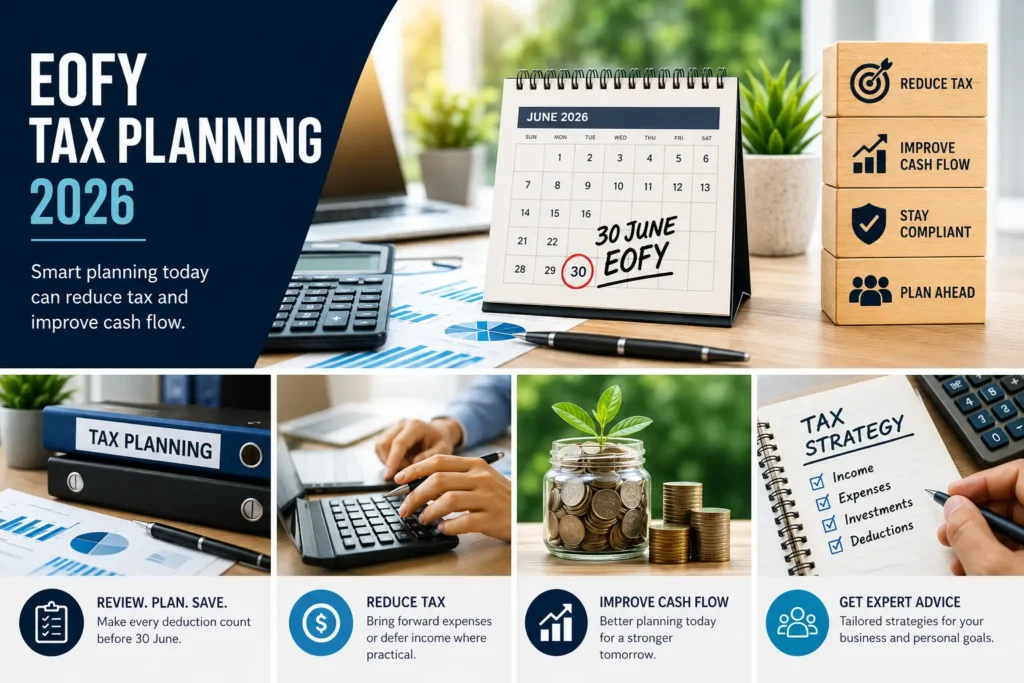
As 30 June approaches, now is the perfect time for individuals and businesses to review their tax position and consider strategies that may help minimise tax and improve cash flow before the end of the financial year.
Early planning can make a significant difference. By preparing an estimate of your taxable income for the year ending 30 June 2026, you may be able to identify upcoming tax liabilities and uncover legitimate opportunities to reduce or defer tax.
Depending on your circumstances, it may be beneficial to:
- bring forward deductible expenses before 30 June; or
- defer income until after 1 July 2026 where practical.
Every taxpayer’s situation is different, and the effectiveness of these strategies will depend on factors such as your business structure, turnover, and whether you use cash or accrual accounting.
1. Deferring Assessable Income
In some cases, delaying the recognition of income until after 30 June may help reduce your current year tax liability.
Strategies may include:
- Delaying invoices for incomplete work until after 1 July
- Deferring receipt of income if operating on a cash basis.
- Postponing lump sum payments where possible
- Reviewing whether certain passive income streams, such as rent or interest, can be delayed.
Where cash flow allows, this approach may help shift taxable income into the next financial year.
2. Bringing Forward Deductible Expenses
Prepaying certain expenses before 30 June may allow you to bring forward tax deductions into the current financial year.
Potential deductible prepayments include:
- Superannuation contributions
- Wages, bonuses, and contractor payments
- Rent and lease costs
- Insurance premiums
- Accounting fees
- Advertising and subscriptions
- Utilities and office expenses
- Motor vehicle expenses
- Repairs and maintenance
- Self-education expenses
- Home office equipment
- Donations to deductible gift recipients
Superannuation Contributions
To claim a deduction for super contributions in the 2025/26 financial year, the contribution must be received by the super fund before 30 June 2026.
Electronic transfers made on 30 June may not clear in time, so it is best to make contributions a few days earlier.
Some low and middle-income earners may also be eligible for a government super co-contribution when making personal after-tax contributions.
3. Capital Gains Tax (CGT) Planning
If you are planning to sell an asset, it is important to remember that the contract date — not the settlement date — generally determines when a capital gain or loss is recognised for tax purposes.
Key CGT Considerations
- Assets held for more than 12 months may qualify for the 50% CGT discount for individuals.
- Deferring the sale of an asset with an expected gain may reduce current year tax.
- Capital losses can offset capital gains and reduce tax payable.
- Selling loss-making assets before year-end may assist where gains have already been realised.
For assets acquired after 21 September 1999:
- Assets held less than 12 months are generally taxed on 100% of the gain.
- Assets held longer than 12 months may qualify for the 50% CGT discount.
The Federal Budget also flagged potential future changes to the CGT system, so it is important to stay informed and seek advice before making significant decisions.
4. Instant Asset Write-Off for Small Business
The instant asset write-off threshold remains at $20,000 for eligible small businesses for the 2026 financial year.
To qualify, businesses must:
- Have aggregated annual turnover below $10 million
- Apply the simplified depreciation rules
- Purchase eligible plant, equipment or motor vehicles costing less than $20,000 per asset.
- Ensure the asset is installed and ready for use between 1 July 2025 and 30 June 2026
Both new and second-hand assets may qualify, and the assets can be purchased outright or financed.
Importantly, the $20,000 threshold applies on a per-asset basis, meaning multiple eligible assets may be written off immediately.
Assets costing $20,000 or more can still be depreciated through the small business depreciation pool.
5. Review Accounts Payable and Accrued Expenses
Businesses operating on an accrual’s basis should ensure all deductible expenses incurred before 30 June are properly recorded.
This may include ensuring supplier invoices are dated on or before 30 June so the deduction can be claimed in the current financial year.
6. Stock Valuation and Obsolete Inventory
Before year-end, businesses should review stock on hand and work in progress to ensure inventory is valued correctly.
Stock is generally valued at the lower of:
- cost; or
- net realisable value.
If stock is obsolete or cannot realistically be sold at its recorded value, a write-down may be appropriate.
7. Writing Off Bad Debts
Businesses using the accrual accounting method should review outstanding debtors before year-end.
Amounts considered genuinely unrecoverable should be formally written off in the accounting records before 30 June 2026 to claim a deduction in the current year.
8. Repairs and Maintenance
Where practical and cash flow permits, completing deductible repairs before 30 June may provide immediate tax benefits.
It is important to distinguish between:
- repairs and maintenance, which are generally immediately deductible; and
- capital improvements, which are typically depreciated over time.
9. Trust Distribution Planning
Businesses operating through discretionary trusts may wish to consider trust distribution strategies, including the possible use of a “bucket company” as part of broader tax planning.
These strategies can be complex and should always be reviewed carefully before year-end.
Final Thoughts
Effective tax planning is not about last-minute decisions — it is about proactive planning and making informed choices before 30 June.
By reviewing your position early, you may create opportunities to:
- minimise tax,
- improve cash flow, and
- ensure your business remains compliant.
If you would like tailored advice on EOFY tax planning strategies for your business or personal situation, contact the team at AJ Buckingham & Associates before 30 June to discuss your options.