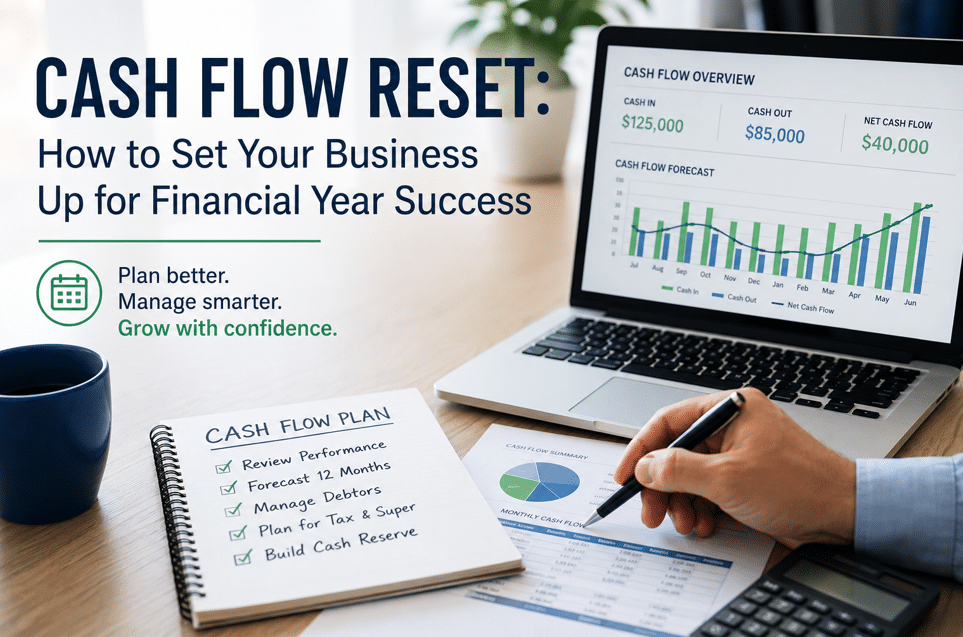
The start of a new financial year is one of the most important planning points for business owners. While tax compliance often takes priority, the real opportunity lies in resetting and strengthening cash flow, so your business is financially stable and prepared for the year ahead.
Strong cash flow management is not just about profitability—it is about ensuring you can meet obligations when they fall due, invest with confidence, and avoid unnecessary financial pressure.
This guide outlines a practical cash flow reset framework designed for small and medium businesses operating under Australian tax and reporting rules.
Why Cash Flow Management Is Critical
Many businesses experience cash flow issues despite being profitable. This usually occurs due to timing differences between income and expenses, particularly where tax and payroll obligations are involved.
Common pressure points include:
- GST obligations through BAS reporting cycles
- PAYG withholding for employees.
- Superannuation guarantee contributions
- Seasonal income fluctuations
- Delayed debtor payments
Without forward planning, these obligations can quickly create liquidity strain, even in otherwise healthy businesses.
Step 1: Review the Prior Year’s Cash Flow Position
Before planning forward, assess how cash moved through your business over the previous year.
Focus on:
- Timing of BAS payments and refunds
- GST cash flow gaps between invoicing and payment
- PAYG withholding cycles and payroll pressure points.
- Superannuation payment timing (same time as Payroll)
- Any tax debt arrangements or payment plans
The Australian Taxation Office continues to increase real-time data matching across payroll and business activity statements, meaning discrepancies or overdue payments are more easily identified.
Understanding how compliance obligations affected your cash position is essential for improving forward planning.
Step 2: Build a 12-Month Cash Flow Forecast (With Tax Timing Included)
A meaningful forecast should reflect when cash leaves your account—not just when expenses are incurred.
Include:
Income
- Monthly or seasonal revenue expectations
- Contracted vs variable income streams
Operating Expenses
- Wages (including PAYG withholding obligations)
- Rent, utilities, and subscriptions.
- Supplier payments and credit terms
Compliance Obligations
- BAS (GST payable or refundable positions)
- PAYG instalments
- Superannuation guarantee contributions
- Income tax provisioning
Irregular or annual costs
- Insurance renewals
- Equipment purchases
- Professional fees
The goal is not perfect accuracy, but visibility over cash peaks and troughs.
Step 3: Tighten Debtor Management Processes
Overdue payments remain one of the most significant causes of cash flow stress.
Improving debtor management involves more than reminders—it requires structure:
- Issue invoices immediately after delivery of goods or services.
- Standardise payment terms (commonly 14–30 days)
- Automate invoice reminders through accounting software.
- Actively follow up overdue accounts using a staged process
- Review clients with consistent overdue payment behaviour.
When GST is payable before invoices are collected, poor debtor control can directly create cash flow shortages.
Step 4: Align Spending with Cash Flow Cycles
Many businesses commit to fixed expenses without considering income variability or tax timing.
Key adjustments include:
- Reviewing subscription and annual commitments for monthly options
- Avoiding large discretionary spending ahead of BAS or PAYG deadlines
- Aligning supplier payments with revenue cycles where possible
- Reviewing staffing and contractor arrangements for flexibility
The objective is to ensure fixed obligations do not exceed predictable cash inflows during lower revenue periods.
Step 5: Actively Plan for BAS, PAYG, and Superannuation
One of the most common cash flow mistakes is treating tax obligations as periodic rather than continuous.
A more effective approach is to:
- Estimate BAS liability monthly and set funds aside.
- Treat PAYG withholding as money held on trust, not working capital.
- Treat superannuation as a fixed payment liability at same time as payroll
- Regularly reconcile obligations against actual performance
Businesses that proactively provision for these costs avoid the typical “tax shock” at quarter-end.
Step 6: Factor in State Payroll Tax Exposure (Where Applicable)
For businesses exceeding payroll thresholds, payroll tax becomes a significant recurring cash flow consideration.
Key points include:
- Calculated on total taxable wages above the threshold.
- Typically, payable monthly once registered.
- Requires group-wide wage aggregation in some cases.
- Can materially impact cash flow during growth phases.
Failure to incorporate payroll tax into forecasting is a common issue for scaling businesses.
Step 7: Build a Cash Buffer Based on Compliance Cycles
A practical cash buffer should reflect not just operating costs, but also tax and compliance timing.
A sensible target is:
- 1–3 months of operating expenses, adjusted for tax obligations
This buffer helps manage:
- BAS and PAYG payment months
- Seasonal downturns in revenue
- Unexpected tax adjustments or reviews
- Delays in debtor collections
It is a stabilising mechanism, not idle capital.
Step 8: Implement Monthly Cash Flow Reviews
Given the structured nature of tax and payroll reporting, cash flow should be monitored consistently—not reactively.
A monthly review should include:
- Actual vs forecast cash position
- Upcoming BAS, PAYG, and super obligations
- Debtor ageing and collection status
- Variance analysis on revenue and expenses
This creates early visibility of pressure points before they become critical issues.
Final Thoughts
Cash flow management is tightly linked to compliance obligations, payroll cycles, and tax timing. A structured reset at the start of the financial year gives business owners a clearer view of their financial position and reduces the risk of avoidable cash stress.
Businesses that actively manage cash flow tend to:
- Meet tax obligations without strain.
- Maintain stronger supplier relationships.
- Make better investment decisions.
- Operate with greater financial resilience.
Need Support?
If you want help building a more structured cash flow forecast or aligning your financial systems with compliance obligations, tailored accounting advice can help you identify risks early and improve financial control throughout the year.
Call us on 03 9435 4444 to speak with our team.