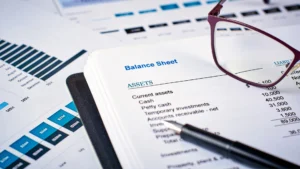
For many small business owners, navigating through financial data can feel overwhelming. While cash flow statements and profit-and-loss reports are more familiar and often analyzed, the balance sheet remains an elusive yet crucial document. However, understanding the balance sheet is vital for evaluating a company’s financial health and making informed decisions.
Whether you’re a business owner, employee, or investor, learning how to read and interpret a balance sheet is a critical financial skill. The balance sheet provides a snapshot of a company’s financial position at a specific moment, outlining assets, liabilities, and equity. These elements together offer key insights into the company’s value and financial stability.
What is a Balance Sheet?
A balance sheet is a financial statement that details a company’s assets, liabilities, and owners’ equity. It reveals the “book value” of a business, showing how much a company is worth as of a particular date. By summing up its assets and comparing them against its liabilities, the balance sheet helps determine the residual value, or equity, that belongs to the company’s owners or shareholders.
The balance sheet is crucial because it provides stakeholders with important information about a company’s resources and obligations. It serves as a snapshot of the financial position of a business, indicating its ability to meet short-term and long-term obligations, and assess its overall financial health.
Why is the Balance Sheet Important?
The balance sheet is a vital tool for both internal and external users, though the way they use it differs.
- Internal Use: When reviewed by company leadership, stakeholders, or employees, the balance sheet helps assess the current state of the business. It provides insights into whether the company is financially healthy, struggling, or thriving. Business owners and management can use this information to make critical decisions, such as adjusting business strategies, correcting course when needed, and capitalizing on financial opportunities. It helps management identify trends, successes, or areas requiring improvement.
- External Use: Investors, creditors, and auditors rely on the balance sheet to determine the company’s financial soundness. For investors, the balance sheet helps in deciding whether to invest in the company by evaluating factors like liquidity, profitability, and debt ratios. Creditors use it to assess a company’s ability to pay back loans and meet its financial obligations. External auditors might review the balance sheet to ensure that the company complies with legal reporting requirements and financial regulations.
Additionally, the balance sheet provides a basis for calculating financial ratios that measure liquidity, profitability, solvency, and overall financial strength. These ratios help stakeholders make informed judgments about a company’s performance and future potential.
Components of a Balance Sheet
A balance sheet is divided into three main sections: assets, liabilities, and owners’ equity. Understanding these components is essential to fully grasping the information the balance sheet provides.
- Assets Assets are resources owned by the company that have a measurable value. They are categorized as either current or noncurrent (long-term) based on their liquidity, which refers to how quickly they can be converted into cash.
- Current Assets: These are short-term assets that are expected to be converted into cash within a year. Common current assets include:
- Cash and cash equivalents
- Accounts receivable (money owed to the company by customers)
- Inventory (products available for sale)
- Prepaid expenses
- Marketable securities (easily sellable investments)
- Noncurrent Assets: Also known as fixed or long-term assets, these are resources that are not expected to be liquidated within the year. Examples of noncurrent assets include:
- Land
- Buildings
- Machinery and equipment
- Intellectual property (patents, trademarks, copyrights)
- Long-term investments
- Goodwill (the value of a company’s brand, customer relationships, etc.)
- Current Assets: These are short-term assets that are expected to be converted into cash within a year. Common current assets include:
- Assets play a critical role in fulfilling a company’s mission. They are the resources that drive production, sales, and operations, and they represent the foundation of the company’s value.
- Liabilities Liabilities are the opposite of assets. They represent financial obligations that a company owes to others, such as debt or unpaid bills. Like assets, liabilities are categorized as current or noncurrent.
- Current Liabilities: These are obligations that must be paid within one year. Common current liabilities include:
- Accounts payable (money the company owes to suppliers)
- Short-term loans or debt
- Payroll expenses
- Rent and utilities
- Taxes payable
- Other accrued expenses
- Noncurrent Liabilities: These are long-term debts or obligations that are due beyond one year. Examples include:
- Long-term loans or bonds payable
- Lease obligations
- Deferred tax liabilities
- Pension obligations
- Provisions for retirement benefits
- Current Liabilities: These are obligations that must be paid within one year. Common current liabilities include:
- Liabilities indicate the financial obligations that must be settled over time, and they are essential for determining the overall financial leverage of a business.
- Owners’ Equity Owners’ equity, also known as shareholders’ equity, represents the residual interest in the company after all liabilities have been deducted from its assets. It is essentially what belongs to the owners or shareholders after the company’s debts have been paid off.
Owners’ equity typically consists of two main components:- Contributed Capital: This is the initial investment made by the owners or shareholders in exchange for ownership shares in the company.
- Retained Earnings: These are the accumulated profits that the company has generated over time, which have been reinvested in the business rather than distributed as dividends.
- Owners’ equity reflects the value of the company that belongs to its shareholders and is a key indicator of the financial health and sustainability of the business.
The Balance Sheet Equation
The fundamental principle of the balance sheet is that it must always balance. This balance is represented by the following equation:
Assets = Liabilities + Owners’ Equity
This equation illustrates that a company’s assets are funded by either borrowing money (liabilities) or by using the owners’ invested capital (equity). The equation can also be rearranged to focus on either equity or liabilities:
- Owners’ Equity = Assets – Liabilities
- Liabilities = Assets – Owners’ Equity
The equation highlights the relationship between the three key elements of the balance sheet and ensures that every transaction affecting one component is accurately reflected in the others.
If a balance sheet doesn’t balance, it is usually an indication that errors have been made during its preparation. Common mistakes include missing data, incorrect transaction entries, or miscalculations related to depreciation, inventory levels, or currency exchange rates.
Conclusion
Understanding how to read and interpret a balance sheet is a fundamental skill for anyone involved in business, whether as an owner, employee, or investor. The balance sheet provides an invaluable snapshot of a company’s financial standing by detailing its assets, liabilities, and owners’ equity.
By mastering the balance sheet, you can gain insights into a company’s financial stability, liquidity, and long-term viability. Whether you’re making decisions about strategy, investment, or compliance, the balance sheet is a critical tool that helps drive informed, responsible decision-making in the business world.